
20190227 CNBC Power Lunch

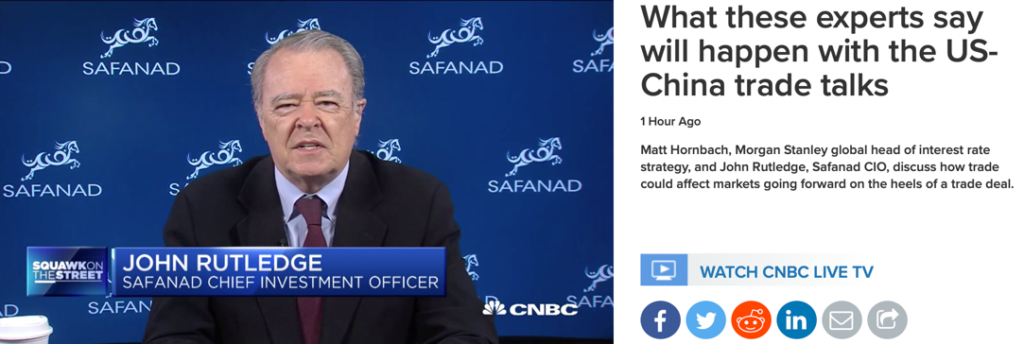
Summary: I spoke with CNBC Power Lunch anchors Melissa Lee and Tyler Mathisen today about global political events and whether it is possible to end up with a trade deal Trump can call a win. You can see a brief video of the spot by clicking here for my answer.
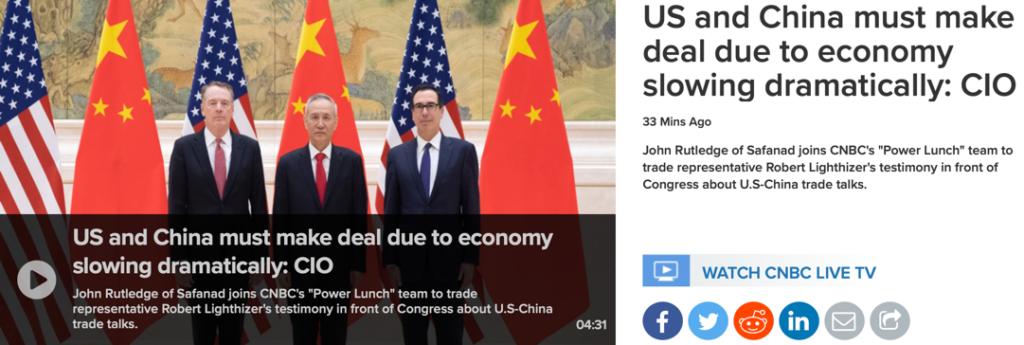
For Congressional testimony watchers, today was like drinking from a fire hose. Fed chairman Powell told us the Fed is likely going to stop selling bonds and shrinking its balance sheet back to normal. Bob Lighthizer, our Trade Ambassador, warned us not to expect to solve all our problems in one trade deal. And Michael Cohen told us told us that working for Mr. Trump is like trying to make a pig sing: it’s a lot of work, the pig doesn’t like it, and when you’re done the singing really all that good. Trump’s meeting in Hanoi with Kim Jung Un had a hard time making it to the front page.

I argued that the reason both sides are ready to make a deal is that it is now obvious to everyone that the trade war virus has spread to other places, asa shown in recent reports from Japan, Taiwan, Hong Kong, Singapore, and even Germany.

Regarding the trade deal, Bob Lighthizer was on target in his testimony. There is likely to be a deal. It will get a lot go things done But it won’t solve all our problems with China for all time. He also suggested that we will see something in the announcement about stabilizing the Chinese currency against the dollar, but that at the moment their central bank was actually propping it up, not pushing it down, a topic he and I discussed at length at the White House a few weeks ago.

In any deal, it is important that both sides can go home and tell their people that they kicked the other guy’s butt. Both sides will be able to do that with this deal. That fact is helped by the fact that most people here can’t read Mandarin and won’t bother to hunt for a translation of Xi’s press release. Hope you enjoy the spot.

JR
Posted in All | Comments Off on 20190227 CNBC Power Lunch

20190225 CNBC Squawk on the Street on how to enforce a trade deal

Summary: This morning I got to talk with Squawk anchors Morgan, David, and Carl about today’s announcement that there will be no tariff hike next week. As I wrote earlier, I believe that a deal will be announced this week. Announcing a deal is easy; enforcing it is hard. But this is an important positive for global markets. You can see the interview by clicking on this link.

As you know, I send talking points to the producers before every show so the anchors know w hat is likely to come out of my mouth. I have copied today’s point below, typos and all.

Rutledge talking points

  • I believe there will be a trade deal this week. March 1 deadline will go away. 
  • I gave a private briefing to the Cabinet, including the whole trade team, in the White House a few weeks ago.
    • Briefed them on the China economy—very weak.
    • Cause of weakness is not the tariffs.
    • Slowdown caused by a severe credit crunch for the private companies that account for 70% of jobs.
    • Credit crunch caused by the collapse of shadow banking industry and peer-to-peer lending.
    • Slowdown has spread to Japan, Taiwan, S. Korea, and Germany due to linked supply chains.
    • I believe both sides ready to make a deal.
    • Elements of a deal that would work include:
      • China agrees to buy a bunch of US stuff (soybeans, steel, …..) This is easy to do.
      • We both agree to take down the tariffs.
      • China agrees to step up IP protection efforts
        • They already have a new law going into effect. 
        • They already have imposed stiffer penalties for stealing technology
        • There is major pressure in China to protect THEIR IP as well. (Think Alibaba)
        • The big issue? Huawei/ZTE/G5. Thats where we need real dialog.
      • You will never get them to stop subsidizing SOEs.
      • They will never agree to reverse their ‘industrial policy’. It is the key to their going from a low-margin assembler of our products to a producer of their own high-value products.
      • US arguments over manipulating their currency make no sense at all. The RMB is still not convertible, i.e., Chinese citizens are still not freely allowed to own foreign assets including dollars.
      • They have been propping the RMB up, not pushing it down. Chinese leaders are deathly afraid of capital outflows. They would welcome a joint statement about stable currency values because it would discourage investors from pulling capital out. 
    • I believe the final deal will look a lot like the above

JR

Posted in All | Comments Off on 20190225 CNBC Squawk on the Street on how to enforce a trade deal