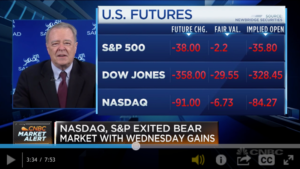
Summary: Every time a politician makes a mess in China or says something dumb about the stock market I get to go on CNBC and talk about the impact on markets and the economy. I have been on a lot lately. Below is a video link and talking points from Thursday’s Closing Bell on 1/3 /18 on Apple and China. I will also do a Worldwide Exchange spot on Monday 1/7/18 at 5AM ET (ouch!) in case you like to wake up in the dark.
I had the opportunity to discuss the Apple/China story with Closing Bell anchors Sara Eisen and Scott Wapner and guest Ravin Gandhi, CEO of GMM Nonstick Coatings. You can see the video by clicking here or by clicking on the image below. I have to thank Ravin for saying “Trade wars are dumb,” which means I didn’t have to say it myself.
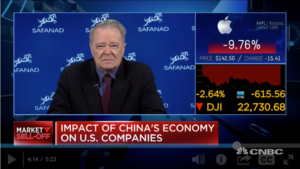 As you can see in the graphic. Apple’s stock had been trashed after CEO Tim Cook’s letter to shareholders the night before reducing its Q4 revenue forecast to $84 billion, $5 billion below the bottom of its guidance range and 7.7% below the median analyst forecast of $91 billion. Lost in the sauce–Apple will still report record earnings. The drop in revenue was entirely due to lower than expected iPhone sales, most of it in China, prompting investors to worry about the impact of the trade war on Chinese growth and what that might mean for the profits of other US companies.
I have copied the talking points, below, that I prepared to brief the anchors before the show. They boil down to two messages: 1) Apple is still a great company and it is way too cheap at its current ($146) price. 2) Anyone in China who can afford an iPhone Xs Max’s $1000-1500 price tag is also a stock market investor. Declining iPhone sales reflect falling Chinese stock prices, not slowing growth. Watch out for more falling revenues stories by US and European luxury good makers in the coming two weeks.
- Apple is one of the top half dozen companies in the world. Nothing in Cook’s letter changes that.
- At this moment, Apple is trading in the aftermarket for $146/share. They have $130B of cash, which means you can buy the business for $118.75/share. They pay a 2% dividend, i.e., they are going to give you $3 of your money back over the next year, which means you are only paying $115.75 per share for the business. That’s 8.3x likely 2019 earnings (7.9x 2020) and 7.5x likely 2019 cash flow (6.8x 2020).
- Did I mention it is one of the best companies in the world?
- I am a buyer at this price but I will buy slowly because people are scared and I might get to buy it even cheaper next week.
- For reasons I spell out below, the real impact of the China slowdown will be on sales of luxury goods and high-end tech products produced by US and European companies. That is where the real bargains are going to be in the coming days.
- China is indeed slowing and will continue to do so gradually for a long time simply because it is getting so big. As the Chinese proverb says, “trees do not grow to reach the sky.”.
- In addition to this downward drift in overall growth rates, there has been a market weakening in recent months as reflected in the shrinking December manufacturing number released this week.
- Some of that is due to the increasingly bitter trade war with the US, but not for the reason many people think. So far US tariffs have excluded iPhones so there is no cost increase there to hurt sales here. In fact, the RMB/US$ has fallen 4.2% over the past year, making lowering Apple’s costs (in US$) for products assembled in China.
- The real damage, as Cook pointed out, is falling sales in China.
- The falling RMB (strong $) has increased iPhone prices (in RMB) for Chinese consumers.
- The trade war has placed pressure on Chinese consumers to reduce purchases of American goods. As I said on a recent show, the trade war’s biggest impact on US companies won’t be from tariffs on US exports, it will be the damage their government does by making daily life more difficult for the many the US companies doing business there.
- But the big factor in falling sales is the trashing of the Chinese stock market this year.
- An iPhone is a very expensive prestige product in China. It is only affordable by upper middle class buyers.
- To a first approximation, every consumer who can afford an iPhone in China is an investor in the Chinese stock market. They have been hurt badly this year. As long as capital continues to flow out of China, this will continue.
- And don’t forget there is a slowdown underway here as well, as illustrated by the sharp drop in the December ISM Index.
- This is why public officials (not using names here) should keep their mouths closed and their Twitter accounts silent about trade issues. Open Mouth Operations are very bad for US companies.
- In addition to these factors, there is a massive story brewing that we have just begun to cover. The US and China are legitimate global rivals now in both economics and technology. Huawei and ZTE are the tip of the spear.
- Whoever controls the rollout of the new high-speed, low-latency global communications network that we call 5G will have a huge edge in future economic and political influence. (You need it for autonomous cars, IOT, etc. But you also need it for communications security and military purposes. China is spending a ton of money romancing other countries into using Chinese network equipment through their One Belt, One Road program. The US is retreating behind our imaginary “wall”. This is the part of the US/China conflict that will still be there the day after the trade dispute goes away.
JR